
DC5 – Psychedelics, attachment-related changes, and mental health outcomes
Description This doctoral project will investigate how psychedelic experiences may facilitate attachment-related psychological changes and their relationship to mental health outcomes. The doctoral candidate will contribute to two complementary studies: a non-clinical investigation of Swedish psychedelic retreat participants and a clinical trial examining psilocybin-assisted treatment for depression in Copenhagen. Both studies employ gold-standard attachment assessments […]
DC6 – Sex/gender differences in psychedelics psychopharmacology
Description Depression and anxiety disorders are more common in women than men, and many women also suffer from hormone-related conditions such as premenstrual dysphoric disorder, postpartum depression, and perimenopausal disturbances. Sex and gender differences in treatment response have been identified, yet no guidelines exist for sex- or gender-oriented psychiatric treatments, including psychedelic therapies. This project […]
DC4 – Mapping the subjective phenomenology of therapeutic and challenging experiences in psychedelic therapy
Description While seemingly rare, sustained difficulties after psychedelic therapy do occur and may have a large negative impact on an individual’s wellbeing. Due to limitations in our understanding and assessment of adverse events, they are likely underreported in current literature. Systematic long-term monitoring and post-trial care are needed to explore and learn from these potential […]
DC3 – Identification of EEG and fMRI biomarkers with potential predictive value for psychedelics’ antidepressant effects
Description Psychedelics have emerged as promising candidates for treating psychiatric disorders, particularly treatment-resistant depression. Recent clinical trials have shifted focus toward identifying biomarkers that elucidate the neurobiology of these substances and their sustained positive effects on mood. Given the rapid onset of psychedelic action, identifying baseline biomarkers is critical for predicting therapeutic success and personalizing […]
DC 2 – The effect of psychedelic substances on synaptic transmission and plasticity
Description A common factor of most antidepressant substances is the enhancement of BDNF synthesis and synaptic plasticity, suggested to be instrumental for the antidepressant effect. Psychedelic drugs seem to be particularly potent in enhancing synaptic plasticity, and the effect appears to be long-lasting. In this project we will select a diverse set of psychedelic substances […]
DC1 – The antidepressant efficacy of psilocybin from a pathophysiological perspective
Description The pathophysiology of major depressive disorder (MDD) is characterized by the loss of synaptic connections in cortical and limbic regions involved in mood regulation. Volumetric reductions in these brain structures have been associated with a more persistent clinical course, including treatment-resistant depression (TRD). Psilocybin has been introduced as a potentially efficacious antidepressant agent in […]
Publication #1 demo
Introducing INTEGRATE
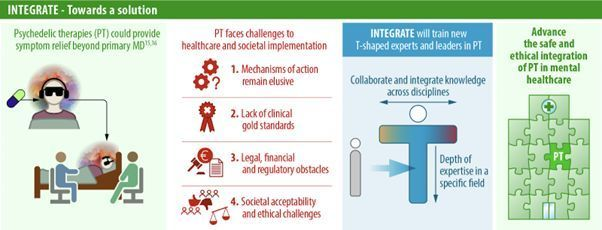
16 PhD Positions and a Milestone for Psychedelic Research Training in Europe We are proud to share that our proposal for a Marie Skłodowska-Curie Doctoral Network has been awarded! Led by Prof. Robert Schoevers and Dr. Joost J. Breeksema, INTEGRATE — the Interdisciplinary Network for Training, Education, and Growing Research into Applications of and Therapeutic Expertise around Psychedelics — will […]